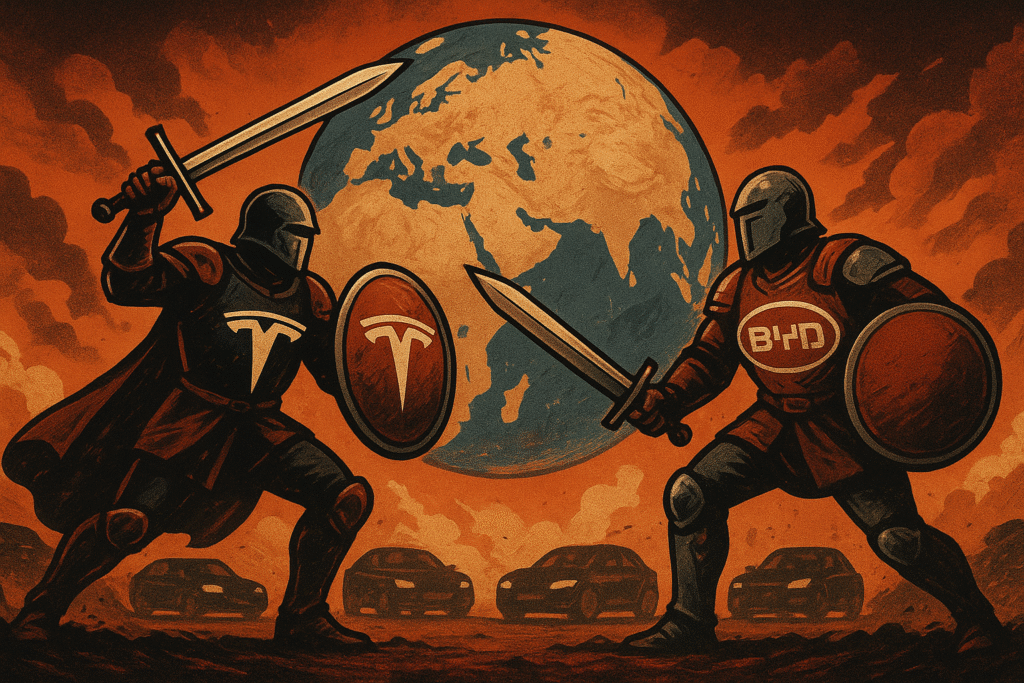
The economic tension between the United States and China has found its sharpest focus yet: the Electric Vehicle industry. China’s massive production capacity, driven by state subsidies and control over critical raw materials, has created an “extinction-level threat” (as dubbed by some US auto groups) to established American players, including the once-unassailable Tesla.
I. The Geopolitical Foundation: Rare Earths and the Supply Chain
China’s dominance in the EV sector is rooted not just in car assembly, but in its near-monopoly over the EV supply chain’s most critical inputs.
- Rare Earth Elements (REE): China controls the majority of global REE mining and an estimated 90% of their processing. These elements (like Neodymium, essential for powerful electric motors) are a strategic chokepoint. The US and its allies are heavily reliant on Beijing for these components, which are used in everything from EVs to advanced defense systems.
- Battery Dominance: Chinese companies, particularly CATL and BYD, lead the world in battery cell production, especially for the lower-cost and highly efficient Lithium Iron Phosphate (LFP) batteries. This integrated control over raw materials and battery technology gives Chinese automakers a massive cost advantage.
II. Xi vs. Trump: The Tariff as a Weapon
The political strategies of the two leaders have directly escalated the trade conflict in the auto sector:
| Leader | Strategic Posture | EV-Specific Action |
| Donald Trump | Protectionism & Tariffs | Imposed a 25% tariff on Chinese-made cars. He has promised to raise this tariff significantly to block the import of cheap Chinese EVs and protect American auto jobs, characterizing the influx as “economic assault.” |
| Xi Jinping | Scale and State Subsidies | Directed massive state support to national EV champions resulting in a massive overcapacity. This strategy forces Chinese firms to aggressively seek foreign markets, driving global prices down. |
Recent High-Level Discussions
Recent meetings between Trump and Xi have primarily focused on de-escalation tactics, such as temporary truces on Rare Earth export controls and the resumption of US agricultural purchases (soybeans). While these gestures calm financial markets, the core issue of EV competition and technology decoupling remains unresolved, with Rare Earths acting as China’s primary leverage point.
III. The Ascent of Chinese Brands: The Threat to Tesla
For years, Tesla was the undisputed global EV leader. However, the rise of Chinese domestic champions like BYD, Nio and others is rapidly eroding this dominance, particularly on the dimension of cost and innovation.
- BYD: The Volume King: BYD has surpassed Tesla as the world’s largest seller of pure Battery Electric Vehicles. BYD’s integrated approach—it manufactures its own batteries and nearly every car component—allows it to produce high-quality, fully-electric models for as low as $10,000 to $14,000 in China. This affordability puts intense pressure on Tesla’s mass-market strategy, forcing it into costly global price wars.
- Nio: The Premium Challenger: Nio targets the premium segment with an innovative business model centered on Battery Swap Stations. This technology allows drivers to exchange a depleted battery for a fully charged one in minutes, solving the anxiety of charging time—a significant competitive advantage over Tesla’s Supercharger network, which requires long stops.
The Blow to Tesla
If Chinese brands were allowed full access to the US market, it would be a colossal blow to Tesla’s market share and valuation. Tesla has relied on being the only viable high-tech EV company. Chinese competitors, offering sophisticated technology at a fraction of the price, would rapidly claim the mass-market segment, severely weakening Tesla’s growth narrative.
IV. The US Market Scenario: An Extinction-Level Event?
Can China Sell EVs in the US?
Direct sales are currently hampered by the 25 tariff. However, Chinese companies have two ways to bypass this:
- Manufacturing in Mexico: BYD and others could establish factories in Mexico, then export vehicles duty-free to the US under the USMCA (North American trade agreement). This strategy is what Trump and US lawmakers are now threatening to block with additional, targeted “reciprocal” tariffs.
- Manufacturing in the US: Building a factory within the US is politically attractive but strategically dangerous, as it would still inject heavily subsidized, non-market competitors directly into the heart of the US automotive industry.
The Size of the Blow
The entry of low-cost Chinese EVs into the US market would have several profound consequences:
- Price Shock: It would trigger a massive price deflation across the entire US EV market, benefiting consumers but devastating the profit margins of US automakers (Ford, GM, Stellantis), who are already struggling to make their EV programs profitable.
- Job Threat: US manufacturers would face overwhelming pressure to cut costs to compete, directly jeopardizing unionized manufacturing jobs, especially in the Midwest.
- Nio’s Advantage: For a company like Nio, securing even a small foothold in the US premium market would be an enormous brand validation. It would give Nio access to deep capital markets and allow it to solidify its global reputation as a genuine technology leader, further accelerating its challenge to Tesla’s premium status.
Ultimately, the US-China EV conflict is a race against time: The US is trying to re-shore its supply chain and build scale, while China is leveraging its current cost advantage to flood the world with affordable EVs before tariffs can completely seal off critical Western markets.