
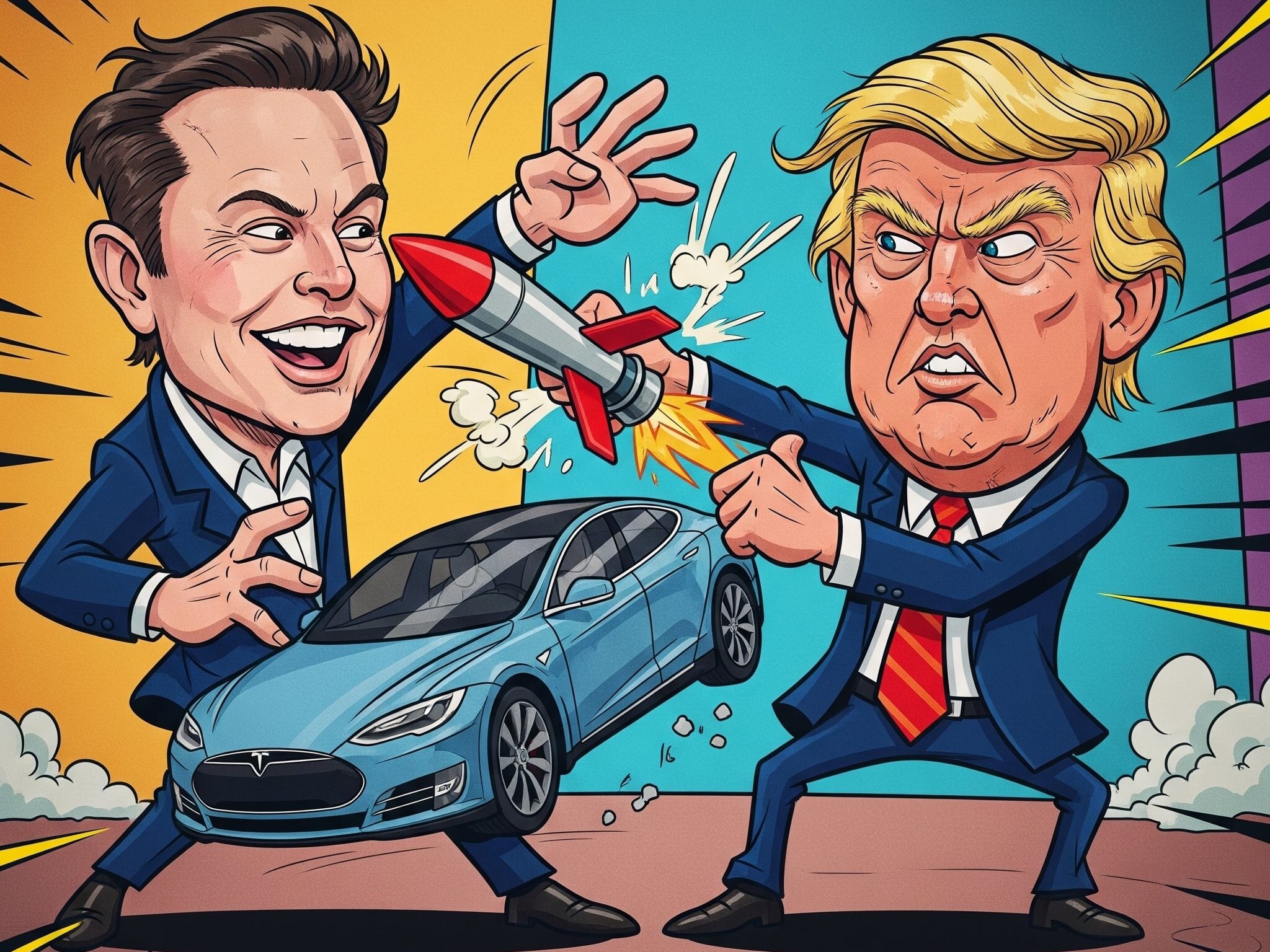
The political sphere and tech world are reeling from a public, vitriolic feud that has spectacularly erupted between President Donald Trump and tech mogul Elon Musk. What was, until very recently, a mutually beneficial alliance has devolved into a bitter “shit show” of personal insults, accusations, and high-stakes threats, all playing out on the dueling battlegrounds of Truth Social and X.
This isn’t just a clash of egos; it’s a conflict with real economic and political implications that could potentially reverberate through the lives of ordinary citizens.
The Honeymoon Ends: From Oval Office Praise to Public Spat
Just days ago, on May 30, 2025, the relationship between President Trump and Elon Musk appeared ironclad. Musk, having just concluded a brief but high-profile stint as the head of the Department of Government Efficiency (DOGE) – a loosely defined but impactful role focused on slashing federal spending – received a glowing send-off from Trump in the Oval Office.
Trump lauded Musk’s contributions, and Musk reciprocated with praise, hinting at an ongoing advisory role. The perception was that of a powerful duo aligned on a vision of governmental reform and a more efficient America.
This harmonious facade shattered with the introduction of President Trump’s “Big, Beautiful Bill,” a comprehensive tax and spending package championed by the administration. Within days of his White House departure, Musk took to X, his owned social media platform, to unleash a tirade against the legislation. He lambasted it as a “disgusting abomination” and “pork-filled,” urging Congress to “KILL the BILL” and warning of its dire consequences for the national debt.
Accusations Fly: The President’s Fury Meets Tech Bro Bravado
President Trump’s initial reaction to Musk’s public dissent was one of “disappointment.” Speaking from the Oval Office on Thursday, June 5, Trump lamented, “Elon and I had a great relationship. I don’t know if we will anymore.” He attributed Musk’s sudden opposition to the bill’s provisions, specifically the elimination of electric vehicle (EV) subsidies that significantly benefit Tesla.
Trump claimed Musk “knew the inner workings of this bill better than almost anybody sitting here” and “had no problem with it” until the EV incentives were cut. He suggested Musk’s reaction was rooted in personal pique, perhaps even “Trump derangement syndrome,” after leaving his White House role.
Musk’s counter-attack was immediate and unsparing. He denied prior knowledge of the bill’s specifics, claiming it “was never shown to me even once and was passed in the dead of night so fast that almost no one in Congress could even read it!”
He then took a direct shot at Trump’s political standing, posting, “Without me, Trump would have lost the election, Dems would control the House and the Republicans would be 51-49 in the Senate.” He added, with characteristic online swagger, “Such ingratitude.”
The verbal skirmish then escalated dramatically. Trump, using his Truth Social platform, fired a potentially devastating salvo at Musk’s business empire. “The easiest way to save money in our Budget, Billions and Billions of Dollars, is to terminate Elon’s Governmental Subsidies and Contracts,” Trump declared, adding, “I was always surprised that Biden didn’t do it!”
This was a direct threat to the enormous government contracts and subsidies that form the lifeblood of SpaceX and have significantly benefited Tesla over the years – a sum estimated by some to be in the tens of billions.
Musk’s response transcended mere policy critique, delving into explosive personal accusations. He retweeted a call for Trump’s impeachment and then, without offering any verifiable evidence, dropped what he called “the really big bomb.” “@realDonaldTrump is in the Epstein files. That is the real reason they have not been made public.
Have a nice day, DJT!” Musk posted on X, referring to the still-sealed documents related to convicted sex offender Jeffrey Epstein. This unsubstantiated claim reignited long-standing speculation surrounding the Epstein case and the powerful figures associated with it. The White House quickly dismissed the allegation as “an unfortunate episode.”
The “Bad Things” and the Bill’s Underbelly
This feud has peeled back layers on the “bad things” surrounding both figures and the legislation at its core.
For Donald Trump, his willingness to publicly threaten a business leader with government retaliation over policy disagreement is a stark reminder of his wielding of executive power. The implication that lucrative federal contracts could be weaponized to silence dissent or punish perceived disloyalty raises serious concerns about the integrity of government procurement and fair business practices. His accusation of “Trump derangement syndrome” is a familiar tactic to dismiss criticism.
Furthermore, the very existence of the Epstein files and the lingering questions about who might be named within them continue to cast a shadow on numerous high-profile individuals, including Trump, who has had documented past interactions with Epstein, though he denies any wrongdoing related to Epstein’s crimes.
For Elon Musk, his rapid shift from a close White House advisor to a staunch critic, especially after benefiting significantly from his association with the administration (Tesla’s stock surged on the perception of his access), raises questions about his motivations.
His public, unverified accusation regarding the Epstein files, while dramatic, falls into the category of irresponsible speculation when made by a figure of his influence, potentially weaponizing unproven allegations for political gain.
His impulsive threat to “begin decommissioning its Dragon spacecraft immediately” in response to Trump’s threat (a threat he later appeared to backtrack from) revealed a willingness to jeopardize critical space infrastructure and active NASA missions for a personal feud.
Musk’s past conduct, including controversial social media posts and his shifting political allegiances, continues to paint a picture of a brilliant but often volatile and unpredictable figure.
The “Big, Beautiful Bill” itself is also under scrutiny. Musk’s initial criticism, while possibly self-serving due to EV subsidy cuts, highlights genuine concerns from some financial experts.
The Congressional Budget Office (CBO) projected the bill would add approximately $2.4 trillion to the national debt over the next decade. While the administration disputes these figures, claiming increased tariffs would offset costs, the sheer scale of the spending package and its potential fiscal impact are legitimate points of contention.
Will We Suffer? The Public Impact of the Billionaire Brawl
The immediate and most tangible impact of this “billionaire beef” has been on the stock market. Tesla’s shares plummeted by over 14% on Thursday, wiping out approximately $150 billion in market value in a single trading day and shaving tens of billions from Musk’s personal fortune. This kind of volatility, fueled by political drama, creates uncertainty for investors and can impact pension funds and retirement accounts indirectly.
Beyond the financial markets, the direct “suffering” for the average citizen is less immediate but potentially significant.
- Policy Gridlock: The public spat has complicated the passage of the “Big, Beautiful Bill,” a legislative package central to Trump’s economic agenda. If this high-profile disagreement creates further divisions within Congress, it could lead to policy gridlock, delaying or derailing initiatives that could affect the economy, social programs, or other areas of public life.
- Government Contracts and Innovation: Trump’s threat to cut government contracts with Musk’s companies, particularly SpaceX, could have far-reaching consequences. SpaceX is a major contractor for NASA, supporting the International Space Station and crucial missions. Disrupting these contracts could delay space exploration, impact national security projects, and stifle innovation that relies on government funding.
- Erosion of Trust: The public witnessing two of the world’s most influential figures engage in such a petty and vindictive exchange, replete with unsubstantiated claims and thinly veiled threats, can further erode trust in leadership, political discourse, and even the stability of key industries. It makes governance seem less about effective policy and more about personal vendettas.
- Precedent for Weaponizing Power: The overt threat to use government power (via contract termination) as leverage in a personal and political dispute sets a dangerous precedent. It raises concerns about potential retribution against any business or individual who dares to criticize the administration, regardless of their contributions to the economy or society.
The Unfolding Drama: An Uneasy Truce?
As the dust settled on Thursday, signs of a potential de-escalation emerged. Musk, perhaps sensing the financial and reputational cost, tempered some of his more extreme statements. Reports surfaced that Trump’s aides had scheduled a phone call with Musk, suggesting an effort to mend fences. Trump himself, ever the pragmatist when the stakes are high, offered a seemingly conciliatory tone.
However, the scars of this public brawl remain. The “Big, Beautiful Bill” now faces an unpredictable opponent in Musk, who has proven his willingness to use his considerable influence to oppose it. The incident serves as a stark reminder that in the volatile arena where tech, politics, and outsized personalities intersect, even the most formidable alliances can collapse with astonishing speed, leaving a messy and uncertain landscape in their wake. The world watches, gripped by the unfolding drama, wondering if this “shit show” will end in reconciliation, further chaos, or lasting damage to the fabric of American governance and enterprise.