
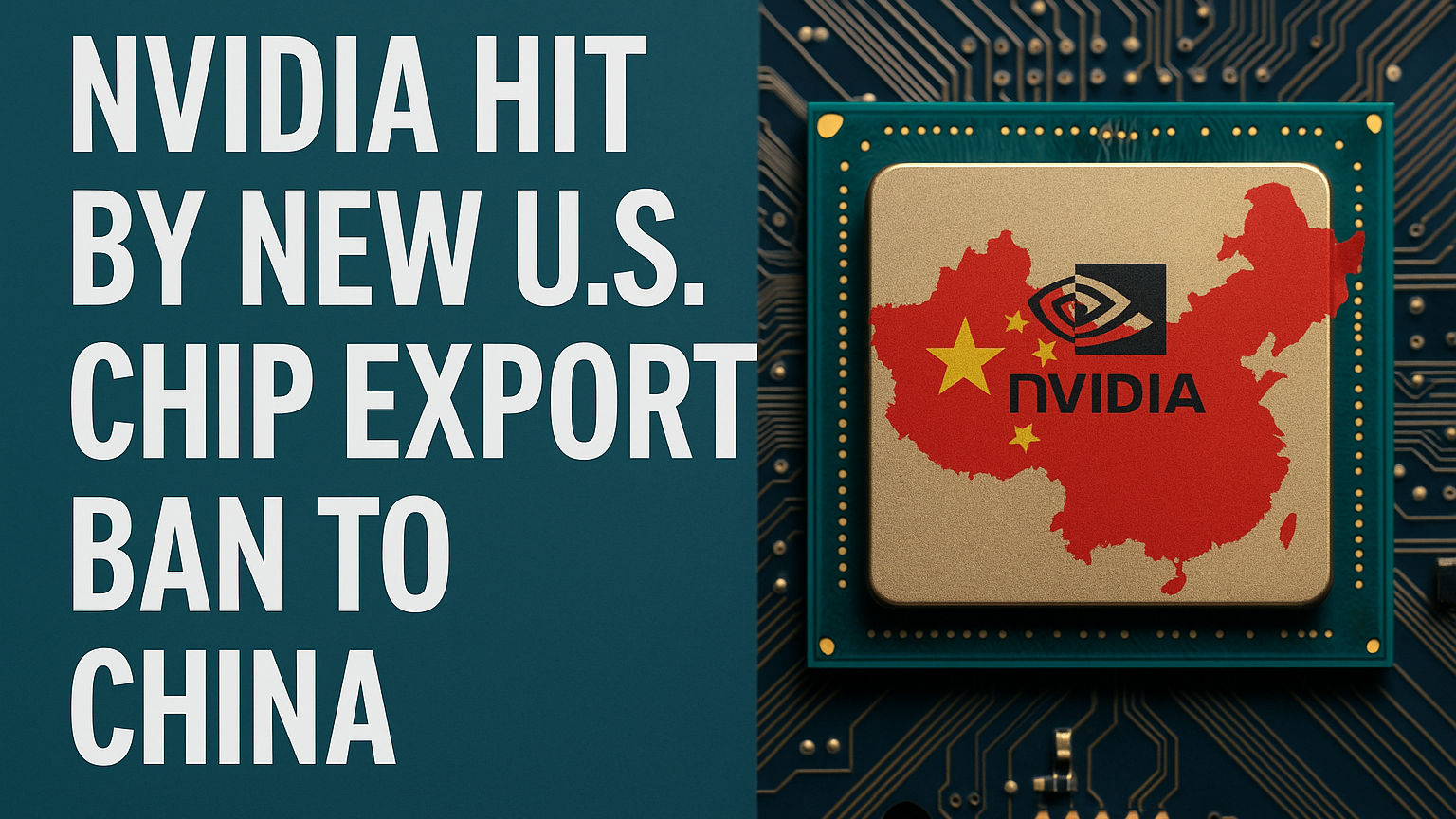
NVIDIA has been on a strong comeback, but fresh U.S. export controls on cutting-edge AI chips are raising new concerns for the company’s growth and its key markets—especially China. Investors are watching closely as this latest move adds uncertainty to the semiconductor sector.
This week, the U.S. government announced a new set of export restrictions aimed at preventing the shipment of high-performance AI chips to China. These controls specifically target NVIDIA’s latest GPUs like the H100 and A100, which are considered critical for advanced AI and military-related applications. The move is part of a broader effort by Washington to limit China’s access to cutting-edge technology that could be used in surveillance or defense systems.
„These measures are necessary to protect U.S. national security interests and ensure that advanced technologies do not enhance foreign military capabilities,” said a spokesperson from the U.S. Department of Commerce
This is not the first time NVIDIA has been affected by U.S.-China tensions. In recent years, especially during the Trump administration, similar export controls and tariffs targeted semiconductor companies, forcing NVIDIA to redesign some products to comply with regulations. Although the Biden administration initially showed a softer approach, the recent tightening signals a continuation of the strategic competition over technology leadership. The semiconductor sector, crucial for both economies, remains caught in this geopolitical crossfire.
Jensen Huang, CEO of NVIDIA, stated in a previous earnings call: “While regulatory challenges create headwinds, our focus remains on innovation to serve the global demand for AI technologies
Economic impact and effects on investors
Following the announcement, NVIDIA’s stock dropped by around 0.3% in pre-market trading, as investors weighed the potential hit to the company’s revenue from China. Experts estimate that sales in China represent a significant portion of NVIDIA’s international business, so these restrictions could reduce growth prospects. However, strong demand for AI infrastructure in other regions, including the U.S. and Europe, may help offset some losses.
“Investors are concerned about near-term revenue dips, but many remain bullish on NVIDIA’s long-term strategy and AI dominance,” noted Mark Lee, portfolio manager at ABC Investments.
Wall Street analysts remain cautiously optimistic. Despite short-term challenges, the long-term growth potential in AI, cloud computing, and data center markets is expected to keep NVIDIA in a dominant position. The company’s ongoing innovation and leadership in AI chip technology provide a buffer against regulatory risks, though the situation remains fluid and dependent on future political decisions.
As of now, NVIDIA has not yet released an official statement regarding the new export rules, but investors are eagerly awaiting the company’s earnings call later this week for further insights. The semiconductor industry as a whole is closely watching how these restrictions will affect supply chains, international partnerships, and innovation.
The challenges facing NVIDIA are a clear reminder of how deeply intertwined technology and geopolitics have become. “The semiconductor supply chain is facing unprecedented challenges, and geopolitical tensions will only accelerate the need for diversification and innovation,” said Dr. Emily Chen, a renowned tech industry consultant.
Investors are watching closely. Mark Lee, portfolio manager at ABC Investments, noted, “While some investors are concerned about short-term revenue dips, many remain confident in NVIDIA’s long-term strategy and its leading position in AI technology.”
At the same time, NVIDIA’s CEO Jensen Huang has emphasized resilience and innovation as key to navigating these obstacles. In a recent earnings call, he stated, “We are committed to pushing the boundaries of AI computing and adapting swiftly to changing regulatory environments to serve global demand.”
These developments underline the importance of closely monitoring both regulatory updates and market responses. For more in-depth analysis of the U.S.-China tech tensions and semiconductor industry trends, readers can explore reports from The U.S. Department of Commerce and market insights on TechCrunch’s semiconductor coverage.
As the situation evolves, Global Pulse News will continue to provide timely updates, helping investors make informed decisions amid an increasingly complex landscape.